Mold Removal in Livingston, LA
Livingston is the parish seat, a small town on US 190 between Satsuma and Albany with an older core of houses near the courthouse and newer subdivisions and acreage homes spreading north and south of the interstate. It sits on higher ground than Denham Springs, but high ground in Livingston Parish is a relative term: the creeks around town backed up in 2016, and the same summer humidity that keeps the whole parish damp doesn’t stop at the town limits.
We remove mold in Livingston. Call and tell us what you see or smell and what got wet.
Mold in Livingston
In the older houses near the courthouse, the call is often a roof that has leaked onto the decking through a season of afternoon storms, which is attic mold remediation. In the newer slab homes it is usually a bathroom wall or a dark ring around one AC vent.
Call Us Now And Tell Us What You See
Tell us where it is, what it looks like, and what has gotten wet. Removal and remediation only — we don’t test.
Found growth in Livingston? Call and tell us where.
Services Available in Livingston
Whole-Home Mold Remediation
Growth in more than one room — a house that took water in 2016 and was closed up fast, a roof that leaked all summer, a place that sat empty with the AC off. One plan, sealed and worked room by room.
Attic Mold Remediation
Dark streaks on the roof deck, a stained ceiling under it, a bathroom fan blowing into the attic, an air handler sweating on its platform. Cleaned in place with the attic sealed off from the rooms below.
Bathroom Mold Removal
The ceiling above the tub, the wall behind the toilet, the floor of the vanity cabinet. Wet every day, and the removal that holds once the water is under control.
HVAC and Duct Mold Remediation
A musty smell that shows up when the air conditioner starts. Growth at the coil, in the plenum, or in wet flex duct — cleaned or replaced so the system stops moving it around the house.
Crawl Space Mold Remediation
Raised houses and camps along the Amite, Tickfaw, and Lake Maurepas hold damp air under the floor for months. Joists and subfloor cleaned, wet insulation out, and the space set up to dry.
Mold Odor Removal
The smell is coming from somewhere. We find the growth behind it and remove it, rather than masking it with a plug-in or a fresh coat of paint.
Mold Removal
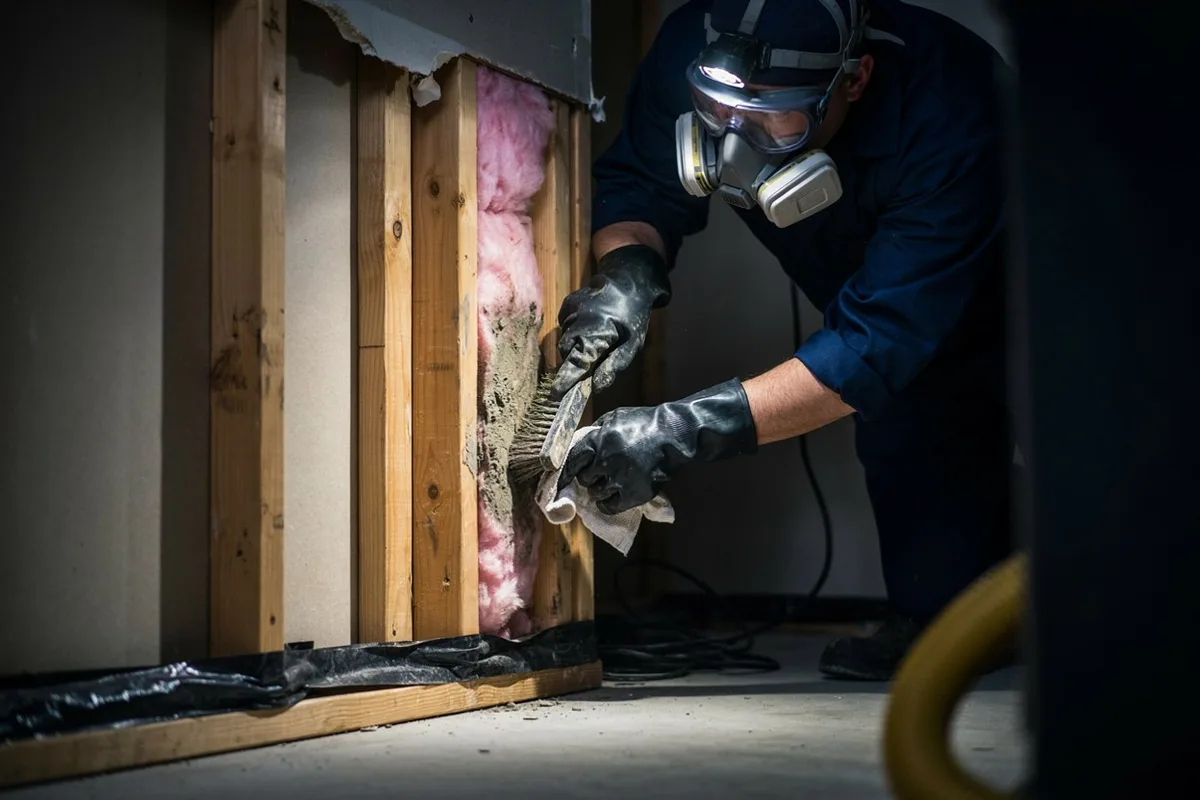
Work area sealed, air kept under negative pressure, wet drywall and insulation out, framing cleaned and dried before the wall closes. Written report at the end.
Black Mold Removal
A dark patch on drywall or a ceiling gets removed the same careful way as any other color of mold. What changes the job is the water behind it, not the shade.